Home Page: Mamoru Kaneko, November 2014
1: He is leading a small
group of researchers.
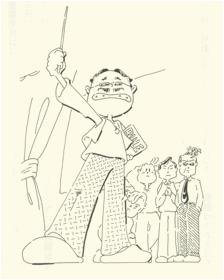
2: You can identify him with a photo.
But the above is closer to reality, and sometimes, he becomes a Shochu man.


3: If you are interested in his uninteresting
curriculum vitae, please click here.
4: His general thoughts on game theory are found in
his book: Game
Theory and Mutual Misunderstanding (Springer, 2004).
5: The SAET 2014 conference will be held at Waseda
University for 19-21, August 2014. You can find the conference homepage: http://www.saet.uiowa.edu/event-14.shtml Also, you can see its beautiful poster.
Research Activities: Papers are listed below.
A:
Inductive Game Theory
B:
Epistemic Logic
Relationships between A and B are discussed in the
following article:
l Two Dialogues on Epistemic Logics and Inductive
Game Theory, Advances in Mathematics Research Vo.12, Nova Science Publisher
l Symposium: Logic and Economics—Interactions
between Subjective Thinking and Objective Worlds, Economic Theory 53 (2013), 1-8.
C:
Social Justice
D:
Housing Markets: Theory and Applications
E:
Other Writings
F:
Articles in Japanese(日本語の論文)
G:
Books in Japanese (日本語の本)
A: Inductive Game Theory:
1: Inductive Game
Theory: Discrimination and Prejudices, (with A. Matsui). Journal of Public Economic Theory 1
(1999), 101-137.
2: Inductive
Game Theory: A Basic Scenario (with J. J. Kline), Journal of Mathematical Economics 44, (2008), 1332-1363.
3: Information
Protocols and Extensive Games in Inductive Game Theory (with J. J. Kline), Game Theory and
Applications 13, (2008), 57-83.
4: Discrimination in Festival Games with Limited Observability
and Accessibility (with A. Mitra), Mathematical
Social Sciences 62 (2011), 34-45.
5: Inductive Game Theory: A
Simulation Study of Learning a Social Situation (with E. Akiyama, R.
Ishikawa, and J. J. Kline). Game
Theory Relaunched, ISBN 978-953-51-1078-1, edited by Hardy Hanappi, pp. 55-76.
InTech - open science, open minds. (2013).
6: Partial Memories, Inductively Derived Views, and
their Interactions with Behavior (with J. J. Kline), Economic Theory 53, (2013), 27-59.
7: Understanding the Other through Social
Roles (with J. J. Kline), to appear in International
Game Theory Review.
8: An
Experimental Study of Behavior and Cognition from the Perspective of Inductive
Game Theory (with A. Takeuchi, Y. Funaki, and J. J. Kline), University of Tsukuba, IPPS.DP.1267.
B: Epistemic logic and Game Theory Applications:
1: Game Logic and its Applications I (with T.
Nagashima), Studia Logica 57 (1996),
325-354.
2: Game Logic and its Applications II
(with T. Nagashima), Studia Logica 58
(1997), 273-303.
3: Common knowledge logic and game logic, Journal of Symbolic Logic 64 (1999), 685-700.
4: Epistemic considerations of decision making in games,
Mathematical Social Sciences 38
(1999) 105–137.
5: Epistemic logics and their game theoretic
applications: Introduction, Economic
Theory 19 (2002), 7–62.
6: Bounded interpersonal inferences and
decision making, Economic
Theory 19 (2002), 63–103.
7: A Map of common knowledge logics
(with T. Nagashima, N.-Y. Suzuki, and Y. Tanaka). Studia Logica 71 (2002), 57-86.
8: Epistemic models of shallow depths and decision
making in games: Horticulture, (with N-Y. Suzuki), Journal of Symbolic Logic 68 (2003), 163-186.
9: Critical
Comparisons between the Nash Noncooperative Theory and Rationalizability (with
Tai-Wei Hu). Logic and Interactive Rationality Yearbook 2012, Vol.II, eds. Z.
Christo, et al. 203-226.
10: Game
Theoretic Decidability and Undecidability (with Tai-Wei Hu), Working Paper No.1410
IRCPEA, Waseda University.
C: Social
Justice
1: The Nash social
welfare function (with K. Nakamura), Econometrica
47 (1979), 423-435.
2: Social Justice, considered in Hell.
This is an English translation of the book of the same title in Japanese. Acts
1 and 2 are only available, so far.
3: Exploring New Socio-Economic Thought for a Small
and Narrow Earth, (2009).
D: Housing
Markets: Theory and Applications
1: The Central Assignment Game
and the Assignment Markets, Journal
of Mathematical Economics 10 (1982), 205-232.
2: Housing market
with indivisibilities, Journal of
Urban Economics 13 (1983), 22-50.
3: Duality in Comparative
Statics in Rental Housing Markets with Indivisibilities (with T. Ito and
Y.-I. Osawa). Journal of Urban Economics
59 (2006), 142-170.
4: This is an excel file for the housing market simulation.
E: Other Writings
1: Utility theories in cooperative games, (with M. H.
Wooders). Handbook of Utility Theory Vol.2. Chapter 19 (2004), 1065-1098.
Kluwer Academic Press.
F: Articles in Japanese (日本語の論文)
1:
「ナッシュ社会的厚生関数の理論」『経済セミナー』1980年4月号100頁-107頁
2: 「地球時代の社会経済思想」『経済セミナー』2008年12月号45頁-52頁
3: 「制度と認識の経済学の構築に向けて」『経済セミナー』2013年10-11月号69頁-75頁 (インタビュー記事、インタビュー:石川竜一郎)
G: Books in Japanese (日本語の本)
1: 『ゲーム理論と蒟蒻問答』日本評論社 (2003)
2: 『詩の饗宴 ゲーム論家の酔夢譚』勁草書房 (2006)
3: 『社会正義 地界で考える』勁草書房 (2007)